Can Seaming Problems: What Buyers Should Check Before Acceptance

An acceptable double seam does four things: it interlocks the can body flange (trimmed body rim) with the end’s counterscore (the lid’s scored groove) so the two cannot pull apart, keeps the sealing compound compressed into a continuous barrier, survives filling, processing, and handling after the seaming head, and measures inside your approved can-and-end specification. Can seaming problems at acceptance mean one of the four has failed. They arrive as a short list: incomplete or dropped, loose, drooped, sharp, damaged, leaking. A droop and a dropped seam can look alike but come from different causes.
This guide covers the acceptance side: what a passing seam must satisfy, which conditions should stop or qualify a factory acceptance test (FAT), and what evidence a buyer should require before signing. It does not repeat the seaming sequence; how the can seaming process works covers that, and it gives no adjustment procedure—that belongs to the named engineer under a logged change. Public guidance points the other way: FDA and CFIA inspection guides evaluate seams in routine production, not a machine being signed off.
It is written for quality, production, procurement, and project teams at can-packing factories preparing a FAT or delivery acceptance.
- The acceptance baseline comes from your approved can-and-end specification, not a generic seam dimension.
- Use the three-class evidence rule: visual screening, seam scope measurement, and leak plus teardown on the same cans.
- Run your own cans and ends, from more than one lot and the tolerance extremes, at the contracted speed.
- Every result must trace to a head, a time, and a material lot—otherwise it is not acceptance evidence.
- What Should an Acceptable Can Seam Achieve?
- Which Seam Conditions Can Affect Equipment Acceptance?
- How Can Cans, Ends, and Handling Affect the Result?
- What Should Buyers Review During a Factory Acceptance Test?
- What Inspection Records Should the Supplier Provide?
- What Should Happen When a Sample Fails Acceptance?
- Foire aux questions
What Should an Acceptable Can Seam Achieve?
Start with the vocabulary; acceptance arguments fail on undefined terms. A double seam is the closure formed by two rolling operations: the first roller curls the end’s counterscore under the body flange, the second irons it flat. Seam scope is the set of measured seam dimensions; overlap (how far the hooks interlock) et tightness (how firmly the layers are pressed) are the two a buyer checks against a drawing. A leaker lets liquid or gas pass; an invert test screens for it.
Those values belong to a body-and-end combination, so a number correct for one size is not a limit for another. If a figure on your acceptance sheet came from an article rather than the maker’s drawings, replace it before the FAT. The can seaming machine buying guide covers how that specification is assembled.
Evidence then falls into three classes, and a serious protocol asks for all three—the three-class evidence rule:
- Visual screening: checked against written criteria under agreed light and magnification—fast, and only a screen.
- Dimensional measurement: seam scope readings with a calibrated gauge or projector, per seaming head, against your specification. The FDA low-acid canned food inspection guide, a legacy page still used by inspectors, defines overlap as the interlock between body hook and cover hook and advises that measurements used to calculate it should not be averaged: the lowest values show the worst case.
- Integrity and destructive checks: a leak or invert test for gross leakers, plus a teardown of the interlock on the same samples. A tear test is a comparative judgment, not a measurement, and should be recorded as such.
A visually clean, leak-passing can can still fail on measurement, so single-test acceptance is weak evidence. Before the FAT, record who declares the baseline, in which document, plus the sampling plan and pass rules.

Which Seam Conditions Can Affect Equipment Acceptance?
Treat each condition below as a symptom, not a verdict. The observation says where to look; measurement and a teardown make it a finding.
| Seam Condition | What You Observe | What to Confirm Before Judging |
|---|---|---|
| Incomplete or dropped seam | The profile is open, or it looks closed while the end lifts off with modest force. | Can seating, head indexing, and whether the set is within drawing tolerance; confirm engagement by teardown. |
| Loose seam | The profile forms, but the layers move and tightness falls outside the specified range. | Body and flange variation, and coating build-up, before blaming roller settings. |
| Drooped seam | The seam wall sags or bulges, often in one section. | Fill state, product temperature, and rim support. A partial droop can come from the package or fill as easily as the head. |
| Sharp seam | A cutting edge or burr that can scratch coating or cut gloves. | Whether surface finish or seaming contact is responsible. Sharpness is an acceptance issue even without a leak. |
| Damaged seam | Deep roller marks, scuffs, coating damage, or a dent distorting the seam. | Where it happened: seaming head, discharge, conveyor, or manual handling; the owner differs. |
| Leaking seam | Water or product seeps at the seam in an invert, pressure, or dye test. | Whether it ties to a measurement, rim contamination, or a mismatched can-and-end set. |
Stage ownership matters as much as the label. Canada’s food inspection agency arranges its metal can defect guide by where a fault originates, from plate and coating through can-body, can-end and double-seam formation to handling. The defect you see may not belong to the closing machine.
Severity differs. A confirmed leaker or dropped seam is a hard stop: the machine has not shown it can close a leak-tight seam on your package. A sharp or damaged seam is a qualifier needing a disposition and a retest, not instant rejection. One out-of-tolerance reading is a finding, not a rejection.

How Can Cans, Ends, and Handling Affect the Result?
Many can seaming problems trace back to the package and the line around the seamer, not the head, so the FAT must exclude those causes on evidence. Four groups matter separately.
- Package components: body diameter and flange thickness vary within a tolerance band, and a can at the loose end seams differently than the drawing suggests. Sealing compound, score, and varnish change the closed profile.
- Matching: body designation and end size must correspond. Mixed lots from two can makers commonly cause intermittent results, so both belong in the trial.
- Product and fill: rim contamination from splash or foam, overfill, viscosity, and particulates in the flange interfere with closure. Headspace and fill temperature change the seam at the head and after cooling.
- Handling after the head: discharge drops, transfer points, accumulation back-pressure, retort loading, and rough handling can distort a seam left in spec.
Machine design interacts with all four. Builders address the fill-contamination path differently: Tengzhuo states that its semi-automatic can sealing machines keep the can body stationary while the head works, intended to reduce splashing on liquid packs. Roller wear matters: a worn roller changes seam geometry over a shift. The supplier states rollers are machined in-house from chrome or stainless alloys, and that format switching uses adjustable lifting trays and quick-release chucks rather than mold changes, rated at about five minutes—each a claim to verify in the trial.
Thermal and pressure load need separate attention. Where a low-acid product is retorted, the schedule is the processor’s documented scheduled process (21 CFR §113.3), at least equivalent to one set by a competent processing authority. The seam must survive that cycle, so a seam accepted dry should be re-verified after processing. For acidified products the boundary is an equilibrium pH of 4.6 or below, with its own record-keeping duties.
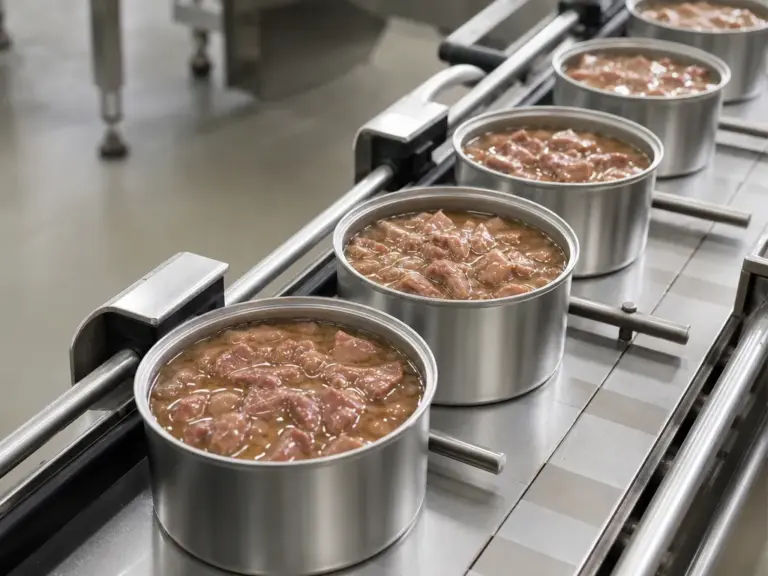
Two consequences follow. The FAT must run your own cans and ends, from at least two lots and the tolerance extremes, and include the downstream step you operate. A seam that met spec only on an empty demo can proves little.
What Should Buyers Review During a Factory Acceptance Test?
A FAT is a controlled demonstration whose value depends on the review list. Put these seven items in it.
- Number and identify the seaming heads, so results trace to a station.
- Confirm tooling for every declared format. Change parts for each contracted size should be present and shown being swapped, not listed on a packing sheet.
- Run at the contracted speed, for a defined duration. Short demos hide heat build-up, roller wear, and stability drift.
- Execute the sampling plan, including restarts. Sample every head at start-up, at agreed intervals, at the end of the run, and after any stoppage.
- Apply all three evidence classes to the same cans, recorded per head.
- Control every adjustment. One named engineer, one change at a time, each logged with results before and after. Acceptance that passes only after several undisclosed changes says something about stability.
- Test containment. Show what happens to cans made between the last passing check and a failure, and who signs the disposition.
Pre-shipment testing is not the FAT. Tengzhuo states every machine passes leak and pressure-resistance testing before shipping; that is a supplier-side check, useful as background, but no substitute for a witnessed run on your package against your criteria.
No rulebook fixes the size of the acceptance run. 21 CFR §113.60(a)–(a)(1) is a production rule: a qualified inspector must visually examine a can randomly selected from each seaming head and record teardown examinations on enough containers from each station at intervals of sufficient frequency. It adds that such measurements should be made at intervals not to exceed 30 minutes and teardown records at intervals not to exceed four hours—advisory figures inside a binding duty. It sets no line speed, run duration, or cans per head. Put those numbers in the contract and protocol, and treat any supplier figure as a proposal.
Acceptance sits inside a shorter purchasing sequence—the five-stage acceptance path. Locking each stage early keeps a seam dispute from becoming a contract dispute.
| Stage | What You Lock Down | Why It Matters |
|---|---|---|
| Inquiry and sample trial | Your cans, ends, product conditions, target output; a trial on your package. | Fixes feasibility before commercial terms; rules out a package mismatch early. |
| Approved baseline | Seam scope readings, leak results, and teardown from the passing cans, countersigned by quality. | Gives the FAT a reference, not an impression. |
| Frozen specification | Can and end drawings with revision numbers, formats, accepted speed range, sampling plan, tooling. | Stops a mid-project change moving the acceptance target. |
| Witnessed FAT | The run, samples, measurements, adjustment log, and open items, signed by both parties. | Makes acceptance a documented event, protecting the payment milestone and warranty. |
| Delivery and after-sales | Commissioning on your line with your lots, spare rollers, and agreed support route. | Confirms the result repeats where cans, utilities, and handling differ. |

What Inspection Records Should the Supplier Provide?
The record set is what you keep after shipment. Ask for these eight documents in the protocol, not on the last day.
- Acceptance protocol: the baseline specification reference, criteria, sampling plan, and who signs each stage.
- Seam scope measurement sheet: readings per head, the instrument, its calibration status, and who took them.
- Visual standard: the reference images or criteria applied, with light and magnification.
- Leak test record: method, media, hold time, and results, with each failed unit identified.
- Destructive inspection record: teardown findings, with interpretation limits stated.
- Run log: speed, duration, stoppages, and the can and end lots consumed.
- Adjustment log: each change, who made it, and results before and after.
- Non-conformance and disposition record, with the tooling and spare-parts list including head and roller IDs.
The test is traceability: every result should link to a head, a time, and a material lot. After delivery, remote review shortens the response—Tengzhuo states its engineers give 24/7 English-language video support on seam adjustment and rollers—if your records travel with the photos.
These records also support duties on the packer. Under Part 113 a US plant thermally processing low-acid food owns the scheduled process and its evidence, et 21 CFR §113.100(e) prescribes what a container-closure record must state: product code, date and time, measurements obtained, every corrective action, signed by the inspector and reviewed by management. Acidified products sit under 21 CFR Part 114 (§114.3). Acceptance evidence substitutes for neither, but records that already fit that format transfer straight into your system.
What Should Happen When a Sample Fails Acceptance?
A failed sample is normal. What matters is a disciplined response and a contract that says who decides.
Contain first. Quarantine everything from the last documented passing check forward, including the failed unit and its neighbors on that head. Set the boundary before the run, not during the argument.
Then classify. Re-inspect the sample and its neighbors: a single unit, a repeating pattern on one head, and a drift across the run are three different problems. Before blaming the machine, pull lot numbers, measure incoming cans, and check transfer points—skipping that is how a FAT blames a seaming head for a can maker’s dimension.
Adjust under control. One change, logged, by the named engineer, with results before and after. Then retest with expanded sampling on that head and its neighbors, because a head-specific cause can show as borderline readings on a neighbor.
Dispose in writing. Pre-agree three outcomes: accept, accept under a written deviation stating its expiry, or hold acceptance. Do not accept a verbal assurance that it was only one can, and do not sign while an unresolved leaker is on the table.
The same sequence applies after delivery, with two additions: response speed, and how long production stays isolated. Agree both before the machine ships.

Foire aux questions
Can a leak test alone prove that a double seam is acceptable?
Non. A leak or invert test finds gross leakers at the moment it runs. A seam can pass while out of tolerance on overlap or tightness and fail after filling, processing, or transport. Combine it with seam scope measurement against your specification and a teardown on the same cans.
Should samples be taken from every seaming head?
Oui. Each head is a separate forming station with its own roller condition and adjustment history, so a pooled sample can hide one weak head. Sample each head at start-up, at agreed intervals, at the run end, and after restarts.
Can a visually normal seam still fail inspection?
Often enough to plan for. Flange engagement, overlap, and tightness are internal geometry, so a seam that looks smooth can measure short of the limit or show coating damage only on teardown. Visual work decides where to look; measurement and teardown decide if it meets spec.
Which can-and-end documents should buyers provide?
Send body and end drawings with revision numbers, materials, coatings, sealing compound spec, and target double-seam values with their source. Add physical samples of every variation you buy, from two lots and the tolerance extremes, plus fill conditions and the downstream process.
When should affected production be isolated?
Immediately once a failing result is confirmed, not after the cause has been discussed. Isolate everything from the last passing check to the failure, including that head’s neighbors if the pattern repeats. Put that boundary rule in the protocol and state who may release quarantined product.
Final Thoughts
Accepting a seaming machine means accepting the seams it produces on your package. That baseline comes from your approved can-and-end specification, not a generic figure, and needs three kinds of evidence: visual screening, seam scope measurement, and leak plus teardown, each traced to a head, time, and lot.
Keep symptoms and causes apart: an incomplete, loose, drooped, sharp, damaged, or leaking seam tells you where to look, while cans, ends, fill conditions, and handling explain much of what you find. Run your own packages at the contracted speed, keep adjustments single and logged, and collect the records as you go.

Continue Reading
Explore more insights from our packaging machinery experts
Wrap-Around, Front-and-Back, and Flat-Surface Labeling Compared
Pressure-sensitive labeling splits by how the container moves and where the label datum sits. Compare the three methods, then send the samples a quotation needs.
Read Article
How Powder Flowability Affects Auger Filling
Air trapped between particles is why powders bridge, compact, and segregate. How flowability drives auger selection, testing, and what to send with an enquiry.
Read Article
Shrink Sleeve Defects: Wrinkles, Distortion, and Label Jams
Sleeve defects sort into four groups: shrink, position, feed, and heat damage. The evidence to collect before any tunnel or applicator setting gets changed.
Read ArticleReady to Upgrade Your Packaging Line?
Get in touch with our engineers for a free consultation and tailored equipment proposal within 24 heures.
Obtenez une conception de disposition de ligne CAO 3D gratuite
- Prix directs en usine
- Délai d'exécution rapide
- Composants mondiaux de premier plan
- Support après-vente dédié


