
A pressure-sensitive label is flat. The container it must stick to usually is not. Whether you need a wrap-around head, two opposed heads, or a flat-surface station is decided by that surface and by which face the label must land on. It is not decided by the artwork or the machine’s rated speed.
All three dispense a label from a moving web onto a surface presented to a head. What changes is how the container travels, what the machine senses, where the datum sits, and what the operator adjusts between SKUs.
One disclosure before the comparison: Tengzhuo builds these labeling machines. Treat every capability statement here as a supplier’s published claim, and verify it on your own containers and your own labels.
Key takeaways
Start with what is common. A label roll sits on an unwind shaft, and the web travels over a tension arm to a sharp dispense edge. There the liner bends away and labels peel off one at a time. A roller, belt, brush, or wipe-down mechanism completes label contact on whatever sits in front of that edge, depending on the application. Depending on the machine and label stock, separate sensors may detect the product and the gap between labels. Transparent or low-contrast constructions may require a specialized sensor. 텅주오의 sticker labeling category page describes label-gap and object-detection sensing and servo or stepper traction. Front-end spacing wheels open a uniform gap before the head.
The difference is what happens to the container. In wrap-around labeling the container rotates as the label leaves the edge, and its rotation pulls the label around the body. Label length relative to circumference decides whether you get a partial wrap, a butt seam, or an overlap. In front-and-back labeling it does not rotate: it travels between two opposed heads, each applying one face. In flat-surface labeling a plane on the product passes the head—endwise on a carton, topwise on a box, pail, or pouch.
That distinction drives the buying decision. Reliable wrap-around application generally benefits from a consistent diameter across the label zone, so it is a cylindrical answer. The other two need a fixed face to arrive in a known attitude. They are therefore guiding and timing answers.
| What it decides | Wrap-around | Front-and-back | Flat-surface |
|---|---|---|---|
| Container movement | Rotates under the head | Travels between two heads | A plane passes the head |
| Placement datum | Label height and dispense start point; clock position only with an orientation system | Face squareness to the conveyor | Edge or corner of the flat part |
| Main adjustment | Centering, 키, wrap angle | Two head positions, guide width | Head height, hold-down, timing |
| Typical containers | Round bottles, jars, cans | Flasked, oval, square bottles | Cartons, boxes, pails, pouches |
| Common application risk | Skew, or a seam in the wrong place | Front-to-back misalignment or skew | Edge lift, or the wrong face |
A pressure-sensitive label conforms only as far as its face material allows; a sleeve conforms after heat. Our comparison of shrink sleeves and pressure-sensitive labels and the sleeve machine buying guide cover that trade-off.
Wrap-around is commonly used for straight-walled cylindrical containers: beverage bottles, round food jars, oil bottles, HDPE chemical containers, and pump and spray bodies. It is chosen when one label must carry both the brand and legal panels. It also suits a graphic that reads continuously around the body.
Three geometry questions decide the result. Is the diameter constant across the label zone? A flat label on a tapered shoulder makes full contact only somewhere. The bridged area is where a wrinkle or a lifted edge appears. Where must the seam sit? A partial wrap hides it behind the body. An overlap puts the label edge on its own print. A butt seam fixes a visible line—a design decision, not a machine fault. If the seam must align with a handle, a mould feature, or the front panel, a separate container-orientation function may be required. Is there a feature to avoid? A parting line, handle, facet, or closure skirt all move the datum.
Label construction matters as much as geometry. Ask the label converter for relevant release, tack, peel, curl, 정기선, and application data for the selected construction, rather than a product name. Release force that is too high or too low can show up as web breaks, labels left on the liner, blown-off or double labels, and lifted trailing edges. The outcome also depends on tension, 속도, die-cut depth, sensor setup, and the peel plate. So judge it on your own labels and line, not on a single datasheet figure.
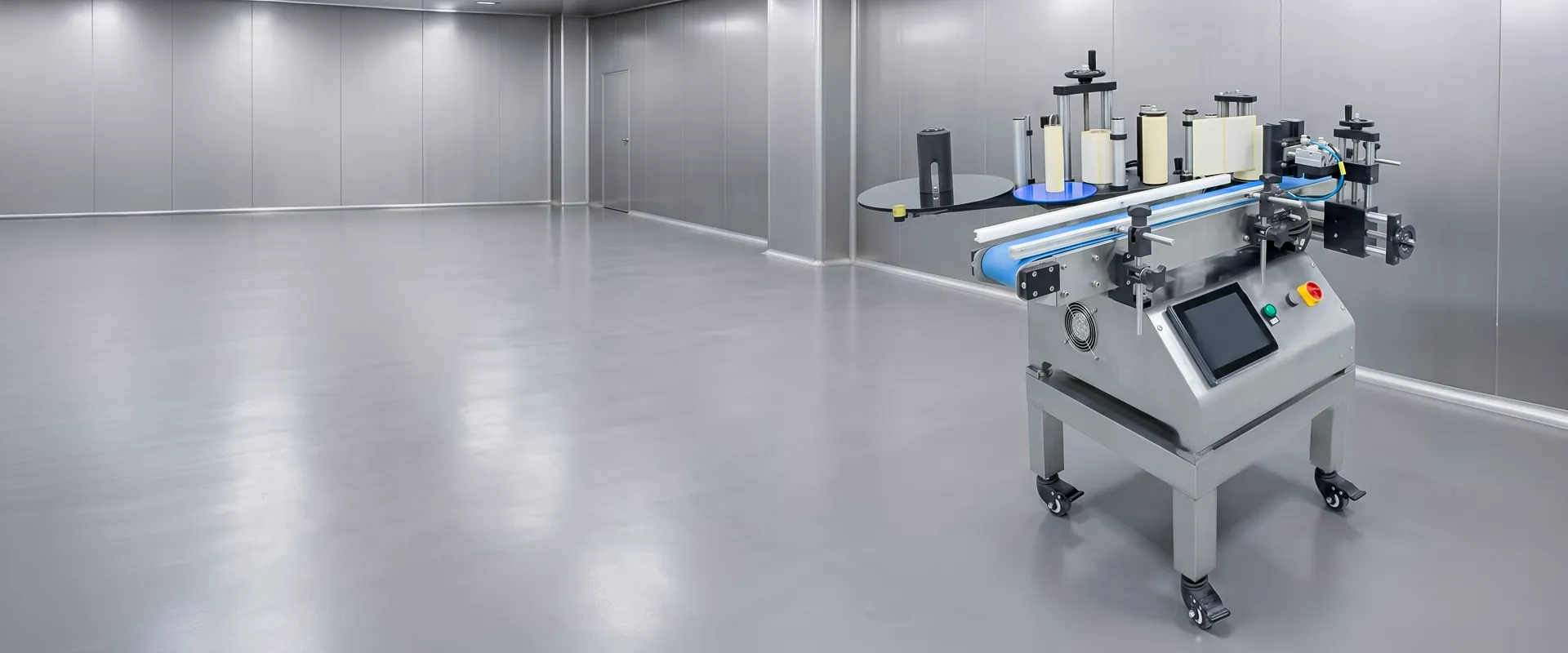
Tengzhuo publishes several machines in this family. They include a benchtop round bottle labeler that completes placement and labeling in one operation. Another is a single-side round bottle labeler with optional simultaneous coding. The family also has a horizontal round bottle labeler for cylinders with no stable base. These cannot be labeled upright on a vertical table.
Front-and-back becomes right when one label cannot present two faces. A flasked shampoo bottle, a rectangular oil jug, a square spirits bottle, or a jar whose label must not cross a seam share one property. Their useful surfaces are separated by a radius or an edge. A single label spanning both would have to gather material in that radius. Separate front-and-back labels can avoid carrying one label across the corner radius.
The consequence is two datums, and the customer sees the relationship between them. If the container arrives yawed, both labels may shift or skew together. If one head is misaligned, the front-to-back relationship may also fall outside the agreed tolerance. Head-to-head registration is therefore a setup task with its own tolerance. 텅주오의 dual-side labeling machine page lists ±1.0 mm labeling accuracy and adjustable conveyor height and width. It also shows visual adjustment of position, 키, and angle.

Oval and flat-sided bottles sit in a middle zone. An oval has two broad faces and two narrow ends, so front-and-back usually works. It works provided the label stays inside the flat area and the corner radius is tight enough that it does not wrap. Measure the usable flat, not the overall width. Tengzhuo’s category FAQ states that its MT-50 semi-automatic machine is for cylindrical round bottles only. It adds that flat, oval, or square containers need a flat labeling machine or a double-sided labeler. This may require a different machine configuration rather than a simple setting change.
Flat-surface labeling puts a label on a plane that is not a bottle face: cartons, folded boxes, clamshells, pouches, pail lids. 텅주오의 flat-surface labeling machine page lists the family as for square boxes and flat products. It states ±1.0 mm published accuracy, a 150 mm label width limit, and a 200 mm conveyor. The page also describes photoelectric sensing with synchronous tracking.
The controlling problem is holding the product still while a label transfers onto it. Bottles, cartons, and pouches all require controlled presentation. Lightweight or flexible products may need extra hold-down and guiding arrangements during label transfer. In this family the design content is guides, hold-downs, and timing: side guides that locate the product, a hold-down that keeps the face presented to the head, and a dispense phase synchronized to conveyor speed. Its setup instructions reduce the job to head height, side guides, and sensor distance.
Two failures are specific here. Edge lift: on a stiff carton the label’s own memory pulls a corner up. That is where mandrel hold and peel values become purchasing information rather than datasheet decoration. Wrong face: if the product can travel in two attitudes, some output gets labeled on the back. That is a feeding and sensing problem, and the reason orientation belongs in the enquiry even for flat work.
| Container form | Application that fits | What to check first |
|---|---|---|
| Straight-walled cylinder | Wrap-around | Diameter range across the label zone |
| Tapered shoulder or hip | Wrap-around, label kept on the straight section | Where the label edge falls against the taper |
| Oval or flasked bottle | Front-and-back | Flat width and corner radius, not overall width |
| Square or rectangular pack | Front-and-back for two opposed faces; flat-surface for top, bottom, or a single presented face | How many faces need a label |
| Carton, pouch, or pail lid | Flat-surface | Hold-down, and which face the sensor expects |
| Ampoule, vial, small cylinder | Wrap-around on dedicated horizontal rollers | Stability at dispense height |
Orientation is required whenever the label must sit at a defined clock position on a container that cannot show you where that is. Triggers include a front panel that must face the shelf, or a label that must clear a handle or parting line. A seam that must fall behind the body, or a flat angled to the mould seam, also counts.
Three families of answer exist, in rising cost. Mechanical keying locates the feature physically: a shaped pocket, a recessed star wheel, a guide that seats the container one way only, or a pneumatic gripper. Feature detection finds the datum and shifts the dispense phase. A sensor reads a mark, seam, or edge, and the controller delays by a measured amount. Active rotation turns the container to the required angle first. 텅주오의 round bottle positioning and labeling machine page describes bottle separation, gripping, positioning, and labeling in one operation. It pairs a pneumatic gripper with a Siemens PLC and stepper synchronization. That page lists no accuracy figure. Treat positioning as a function to demonstrate on your container, not a number to compare.
Sensing is the quiet decision, and transparent labels expose it. A label-gap sensor reads the boundary between face material and liner by how much light the web passes or reflects. A clear film on a clear liner can present almost none of that difference. Tengzhuo’s category FAQ notes that standard photoelectric sensors may not reliably read clear labels on clear liners. A sensor compatible with the actual label construction should therefore be specified in advance. Confirm it on your trial labels.

Send representative containers covering the relevant cavity and production variation. Diameter varies by cavity, and the head centers on the extremes. Send labels on the actual stock, in the actual wound condition, with face material, adhesive, 정기선, die-cut, and varnish named. Tengzhuo states it supplies an unwind chart with the order—core size, maximum roll diameter, required unwind direction—to give your converter. Ask for it before the first label order, since a wrong unwind direction can make a good machine unusable. Ask the converter to confirm unwind direction, core size, and static control for the roll format you order.
Then define placement in words an acceptance test can use: which face is the datum, and how it is identified on a bare container. State the permitted deviation and seam position, and what counts as a visible defect at a given viewing distance. A written label ordering spec—face, adhesive, 정기선, die-cut, 코팅, and unwind direction—covers most of the label-side detail. If the label carries a barcode, check it after application. A symbol that prints well can read badly once stretched over a radius or caught under a lifted edge. That is why GS1’s barcode standards matter.
| What to send | Why it decides the outcome | What to record |
|---|---|---|
| Containers, multiple cavities | Centering follows the extremes | Diameter or flat width per cavity; height per lot |
| Labels on real stock | Release force, curl, and tack are laminate properties | Face, adhesive, 정기선, die-cut, coatings |
| Unwind direction and roll format | A wrong unwind runs the web off the sensor | Core size, maximum diameter, gap and join policy |
| Written placement datum | Without a named datum, no tolerance can be tested | Deviation per unit, measured the same way |
| Every SKU, including next year’s | Size ranges follow the extremes you declare | Changeover time and parts touched per switch |
| Line context and constraints | Spacing, handoff height and guarding shape the station | Infeed pitch, conveyor height, air, floor space |
A published tolerance is a claim about a measurement, so ask for the measurement. Tengzhuo’s dual-side and flat-surface pages both state ±1.0 mm labeling accuracy. The positioning page states none. Neither tells you which container, label size, or gauge was used. A tolerance is only as good as the gauge behind it, so agree which instrument measures the result. Confirm it is calibrated before the machine is judged. Tengzhuo describes scaled multi-axis head adjustments. The actual changeover time should be measured between your agreed formats during acceptance testing.
Within its declared ranges, usually yes. Each machine publishes a label size window and a container size window. Staying inside both is setup: 머리 높이, side guides, sensor distance, dispense length. Outside them you are changing the machine’s family, not its settings. Check your largest and smallest label, not the middle one.
That is one of the most common reasons this application is chosen. The label must fit inside the flat area without crossing the corner radius, Measure the usable flat and the radius, not the overall width. Tengzhuo’s FAQ directs flat, oval, and square containers away from its round-bottle semi-automatic machine. It points them toward a flat or double-sided one.
자주, 예. A label-gap sensor works on the optical difference between face material and liner. A clear face on a clear liner can give too little for a standard sensor to count reliably. Tengzhuo states that a dedicated sensor must be specified in advance. Confirm it on the labels you actually buy, not a sample roll.
Name the datum, then state the deviation from it. Without a datum a tolerance is unmeasurable. Say which face, edge, or mould feature the measurement starts from, and how far the label may sit. Also state who measures, with what gauge, and when. Record deviations against the defined sampling plan and measurement frequency rather than picked samples.
Enough containers to cover cavity and lot variation. Send enough labels to complete the agreed setup, trial run, inspection, and repeat test in the real unwind direction. Add your worst label—the smallest, longest, clearest, thinnest liner—plus a written placement requirement and a photo of the pack as it should look. A trial on your material is a purchase decision; a trial on the supplier’s stock is a demonstration.
Choose the application from the container, not the artwork. A cylinder that can rotate is a wrap-around job. Two separated faces are a front-and-back job. A plane on a carton or lid is a flat-surface job. A feature that must land at a clock position is an orientation question. Then send real containers, real labels, and a measurable placement requirement. Judge the result on your own gauge.
Before requesting a quotation, send Tengzhuo representative containers and production label rolls. Also include the required unwind direction, target output, and a measurable placement standard. These details allow the team to recommend the appropriate wrap-around, front-and-back, flat-surface, or positioning configuration for a trial.


