Наполнение высоковязких продуктов частицами: Методы и требования к исследованию
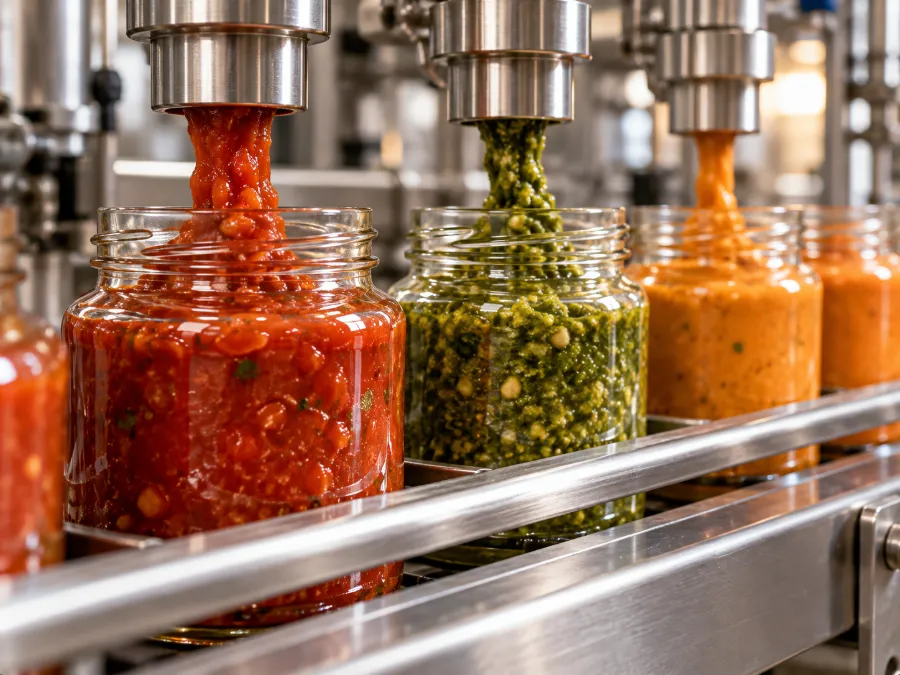
A thick product is not one problem but several. Honey that flows easily when warm and sets when it cools, a chili sauce whose chunks must survive the journey from hopper to jar, and a lotion that strings into the bottle threads all resist filling for different reasons. Each one answers to a different part of the machine, and each one needs a different set of measurements before anyone can propose a solution honestly.
What decides the outcome is a set of properties rather than a product category: how the paste flows under the shear and temperature it will actually meet, which metering methods are worth evaluating, what particles do to the product path, how accuracy trades against output, and what a trial needs before anyone can quote. That is why viscosity ceilings, tolerances, and rates are not given here as universal numbers: they belong to a specific product, container, and machine combination.
Written for food, sauce, cosmetic, personal-care, and chemical manufacturers filling viscous or particle-containing products.
One disclosure: Tengzhuo builds the equipment discussed here, so read every capability statement as a supplier’s claim attributed to a published page, and verify it against your own product and containers.
- Viscosity is only meaningful with a temperature and a shear rate attached; a single figure rarely describes a paste.
- Particles are a product-path problem: valve passage, nozzle shut-off, and hopper agitation all have to agree with chunk size and concentration.
- Accuracy and output compete through the same settings. Decide which one the acceptance test measures before the trial.
- Send the product, the containers, and the acceptance limit together. A trial without all three answers nothing.
Which Product Properties Affect High-Viscosity Filling?
Start with the fact that most pastes are not simple fluids. A thick sauce, cream, or adhesive rarely has one viscosity; its resistance to flow changes with how hard it is being moved and for how long. That is why ASTM D2196, the standard test methods for rheological properties of non-Newtonian materials by rotational viscometer, specifies a procedure with defined spindle, speed, and temperature rather than a single number. Ask your QC or contract filler for a measurement taken the way you will use it: at the temperature the product sits in the hopper, and across a range of shear rates if you can.
Temperature deserves its own line, because it silently changes the machine’s behavior. A product that flows at 45°C can half-set at 20°C, and a hopper that ran well in the morning can under-fill in the afternoon as the batch cools. Tengzhuo’s paste filling category page describes double-layer heated mixing hoppers and heating jackets with mechanical agitators for products such as wax or thick honey that stiffen at room temperature, and for keeping a batch from separating or settling. Treat those as configurations to ask about when temperature is your failure mode, not as a default on every quote.
The other properties that decide the outcome are the ones a data sheet rarely carries. Stringing or tailing happens between cuts and shows up on bottle threads and the conveyor. Particle size and concentration decide whether the product path will pass or plug. Settling decides whether the first jar and the last jar of a batch contain the same thing. Aeration decides whether a fill that weighed correctly at the nozzle still reads correctly once the foam collapses.
| Product property | What it does on the line | What to measure before you ask for a machine |
|---|---|---|
| Viscosity and flow behavior | Sets the driving force needed and how cleanly the cut-off lands. | A rotational viscometer reading at hopper temperature, across more than one speed. |
| Temperature response | Drifts fill volume through a shift as the batch cools or stiffens. | The temperature range your shop floor actually reaches, and where the product is held. |
| Particle size and concentration | Plugs valves and nozzles, or shears the pieces you are selling. | Largest and longest piece in the recipe, plus the percentage by volume. |
| Settling and separation | Makes the first and last containers of a batch differ. | How long the batch sits before and during filling, and what it looks like after. |
| Stringing and aeration | Soils closures and conveyors, or leaves foam that collapses after the fill. | Whether the product tails between cuts, and how much air whipping introduces. |
Which Filling Methods Can Be Evaluated?
For thick products the shortlist is usually positive-displacement filling: a known volume is metered and pushed out, so the fill does not depend on the product draining under gravity. Within that family the practical differences are how the metering element is driven, what the product path looks like, and whether the machine holds its metering as conditions change.
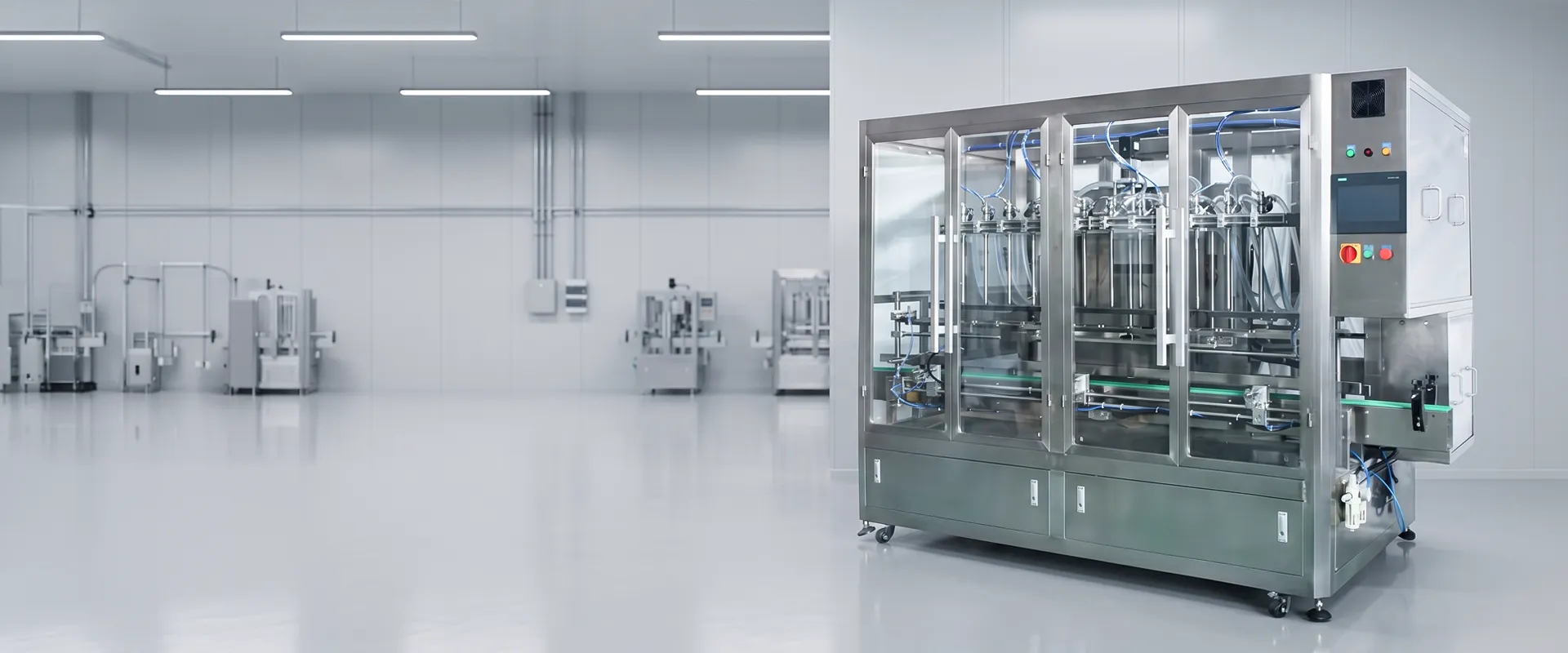
Piston filling is the first method to evaluate. Tengzhuo’s page describes industrial-grade pneumatic cylinders driving dense pastes with volumetric metering, and separately lists servo-driven piston models. The distinction matters to a buyer: a pneumatic arrangement needs a compressed-air supply, which the company’s own FAQ confirms, while a servo drive gives you programmable stroke and speed rather than a regulator setting. Pump-based methods, including the rotor pump fillers listed in the same category, meter through a rotating element instead of a cylinder, which changes what happens to a chunk and what happens to the cost of cleaning.
Where the product is heat-sensitive, priced by weight, or sold in a flexible format, two other configurations are worth asking about: a heated and insulated machine for products that must stay warm through the run, and a weighing-based filler for bag formats. Tengzhuo lists a heating and insulation filling machine described as servo-heated and temperature-controlled for viscous pastes containing particles, and a semi-automatic bag filler that weighs as it fills.
What none of these lists is a viscosity ceiling. Any statement that a method handles “up to X” without a named product, a temperature, and a nozzle is a description of a test someone ran, not a limit you can buy. Our guide to choosing a filling machine by product type covers the wider method comparison. The focus here is the thick end of that range.
How Do Particles Affect Valves, Pumps, and Nozzles?
A chunk travels a short but demanding route: hopper, valve or pump, product tube, nozzle, and the falling distance into the container. It can be stopped at the first two, cut or mashed at the third, and mis-placed at the last. The two failure modes are not the same, and they have different fixes.
Blockage is the obvious one. Tengzhuo’s page describes heavy-duty rotary valves with widened passageways, and its FAQ states the same design intent for products such as chili sauce and jam: allow large particulates to pass without being crushed. Read that as a design claim to test with your recipe, because a passage that clears a chili seed may still bridge on a long fiber or a soft fruit piece that folds rather than flows.
Damage is quieter and more expensive, because it changes the product you paid for. Shear-sensitive pieces survive a wide-bore path and a slow stroke and lose their shape in a tight pump or a fast one. If the chunks are the selling point, ask to see filled containers from the trial and compare the pieces against the same product stirred by hand. It takes one afternoon and settles what a specification sheet cannot.
The nozzle is where the two meet. An internal shut-off and an anti-drawing action are what keep a thick product from tailing after the cut, and Tengzhuo describes pneumatic anti-drawing nozzles for exactly this, with the stated goal of a clean cut-off. What the description cannot tell you is whether your particle load keeps that shut-off seating cleanly. A seed lodged in the seat will leak, and one leak on a thread is a rejected case later.
How Do Accuracy and Output Affect Each Other?
Throughput and accuracy compete for the same physical events. A faster cycle gives the product less time to leave the nozzle and less time for the surface to settle, which tends to widen spread on a thick material. A slower cycle gives the batch more time to cool and the particles more time to settle, which moves the mean even while it tightens the spread. This is why a machine that holds its volume in a morning demonstration can drift across a full shift.
Separate two ideas that get merged in conversation. Accuracy is how close the fills are to the target; repeatability is how close they are to each other. A filler can be tightly repeatable around a volume that is wrong for your declared weight, and a supplier’s figure quoted as a single percentage rarely says which of the two was measured. The NIST/SEMATECH e-Handbook section on bias and accuracy is a useful reference for the distinction, and the practical version for a filling trial is to record enough consecutive containers to see both the mean and the spread rather than a best-of-three.
Decide the measurement method before the trial, not after. Gravimetric checks on a balance are the cleanest way to judge a paste, because a volume read on a tapered jar is a reading of the glass as much as of the machine. Volumetric settings are still what the machine controls, so record both: the setting used, and the weight it produced, with the product temperature beside it. Our article on testing filling accuracy before production sets out a procedure, и the follow-up on accuracy issues in production covers what usually moves after commissioning.
| Setting you can change | What it tends to improve | What it tends to cost |
|---|---|---|
| Cycle rate | Containers per hour, and the payback case for the line. | Fill spread on thick products, and cleanliness of the cut-off. |
| Number of filling heads | Output without shortening any single cycle. | More product paths to clean, and more heads to keep agreeing with each other. |
| Hopper temperature | Flow, and a cleaner cut at the nozzle. | Product quality risk if the material is heat-sensitive, plus energy and cool-down time. |
| Agitation speed | Consistency of particle distribution through the batch. | Piece damage and air entrainment if run too hard. |
| Nozzle cut-off | Cleaner threads and a drier conveyor. | A tighter tolerance for particulate sitting in the seat. |
How Should Cleaning and Changeovers Be Planned?
On a paste line, cleaning is not a hygiene chore but a capacity item. If a changeover takes two hours and you change products four times a week, the machine’s rated output is not the number that matters. Tengzhuo describes tool-free tri-clamp connections on 304/316L contact parts, with the stated intent of letting operators dismantle the hopper, rotary valve, and piston cylinder for a washdown in minutes. Time it yourself with your own crew and your own product, because “minutes” is a claim about a configuration, not a measurement of your shift.
Plan the changeover around three questions. What has to come apart to reach every wetted surface, and where are the dead legs a thick product will sit in? What has to be heated or cooled before the next product can run, and how long does that take in your room temperature? What is the first-off container going to be, and who decides whether it passes? A changeover procedure that answers those in writing is worth more than a shorter quoted clean time.
If the line also runs regulated product, the equipment expectations are documented rather than negotiated: 21 CFR 211.65 covers equipment construction surfaces and 21 CFR 211.67 covers equipment cleaning and maintenance records. Whether those rules apply to your product is a question for your own compliance lead; the useful part is that they describe the shape of evidence a buyer should expect to keep.
What Should Buyers Provide for a Representative Filling Trial?
Ask for a trial on your product, in your containers, with the settings recorded. The inputs that make that possible are few, and a quote that skips them is guessing.
Send enough product to run a sequence rather than a demonstration: a start-up, a steady state long enough to show drift, a changeover, and a retained sample. Ask what the supplier’s rig consumes at your container size; that determines whether your quantity is adequate. Alongside the product, send the rheology reading at hopper temperature if you have one, the largest and longest piece in the recipe with its percentage, the container samples with their neck and body dimensions, the target fill with its tolerance, and your line speed target. State your air supply, your available heating, and your cleaning method; a pneumatic machine without compressed air is a project that stops on delivery day.
Then agree what passes before the first container is filled. For a chunky product, the pass criteria are usually three: weight spread across a run, the condition of the pieces after filling, and how clean the threads and conveyor stay. A trial that measures only the first of those will produce a machine that fills accurately and soils every fourth jar.
Tengzhuo builds the machines discussed here, so supplier statements are claims to verify on your own product, not measured results, and no viscosity limit, tolerance, or output figure here is transferable. Regulatory references apply to regulated products; confirm applicability with your own compliance contact.

Часто задаваемые вопросы
Can one filler handle products with different viscosities?
Sometimes, within a range that has to be defined by the two products rather than by a catalog. A thin lotion and a set wax may share a frame and not a nozzle, a hopper jacket, or a cut-off. The practical test is to run both products back to back, including a changeover between them, and record the settings each one needed. If the changeover requires tools or a long clean, you have two machines on one frame.
Can a piston filler handle products containing particles?
It depends on the valve, the passage, and the piece. Tengzhuo describes heavy-duty rotary valves with widened passages intended to let large particulates through without crushing them, which is a design claim to verify with your recipe. Judge the result on filled containers: compare the pieces against hand-stirred product, and check that the nozzle shut-off still seats cleanly with the smallest particle in your mix.
Does heating improve filling performance for every product?
Нет. Heat lowers viscosity for many products, which helps flow and cut-off but can also drive off volatiles, change texture, separate an emulsion, or shorten shelf life. For products that genuinely stiffen at room temperature, a heated hopper is the right configuration; for others it fixes a filling symptom and creates a quality problem. Establish the temperature window the product tolerates before you size the heating.
How much product is needed for a representative trial?
Enough for a start-up, a steady-state run long enough to show drift, one changeover, and a retained sample. Ask the supplier what its rig consumes at your container size and fill volume before you commit a quantity, and send containers with the product rather than relying on the test bottles at the factory. A trial on a half-empty hopper shows neither settling nor temperature drift.
Should fill accuracy be evaluated by weight or volume?
Judge by weight and record the volume setting, because a paste that entrains air or carries pieces does not have a stable density. Weigh enough consecutive containers to see both the mean and the spread, note the product temperature beside them, and compare against your declared fill. If the two disagree by more than the tolerance allows, the density assumption is the thing to investigate.
A viscous product is a set of behaviors rather than a single number, and a filling machine is a set of choices rather than a category. The work that decides the outcome happens before the quote: measure the product as it will actually be handled, describe the pieces honestly, and insist on a trial that runs your recipe in your containers with the settings written down.

Continue Reading
Explore more insights from our packaging machinery experts
Обертывание, Спереди и сзади, и маркировка на плоской поверхности в сравнении
Этикетки, чувствительные к давлению, разделяются в зависимости от того, как движется контейнер и где находится опорная точка этикетки.. Сравните три метода, then send the samples a quotation needs.
Read Article
Как сыпучесть порошка влияет на заполнение шнека
Воздух, запертый между частицами, является причиной образования мостиков в порошках., компактный, и отделить. Как текучесть влияет на выбор шнека, тестирование, and what to send with an enquiry.
Read Article
Дефекты термоусадочной втулки: Морщины, Искажение, и этикеточные джемы
Дефекты гильз разделяют на четыре группы.: сокращать, позиция, кормить, и тепловое повреждение. The evidence to collect before any tunnel or applicator setting gets changed.
Read ArticleReady to Upgrade Your Packaging Line?
Get in touch with our engineers for a free consultation and tailored equipment proposal within 24 часы.
Получите бесплатный проект макета линии в 3D CAD
- Прямые цены с завода
- Быстрое время выполнения работ
- Глобальные компоненты высшего уровня
- Выделенная послепродажная поддержка


