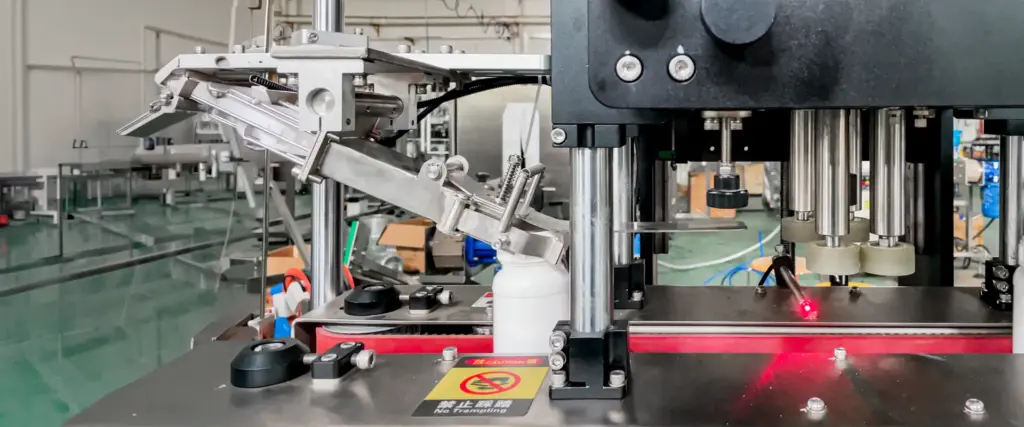
A cap that reads tight at the capper and loose at the warehouse is a different failure from a cap that did not get tight at all. The first is a torque-retention question: something took the clamp load away. The second is an application question: the capper, its wear parts, or the package did not deliver the assumed torque. Both arrive as one complaint, so adjustments get made against the wrong assumption.
Work the failure in order: package, then placement and applied torque, then bottle control and worn parts, then product and storage. Only then touch the machine. This guide gives no torque value: the published methods measure torque retention, and targets belong to your closure specification. On the machine side, the capping machine types guide shows which head design fits which closure.
One disclosure: Tengzhuo builds the machines discussed here, so treat each capability statement as a supplier’s claim attributed to a published page. Every outside source is named.
Written for quality and procurement teams working a loose-cap complaint.
The package sets the ceiling: a capper cannot put clamp load into a closure that will not hold it. With a continuous-thread closure, two conditions must be true at once—the threads engage without cross-starting, and the liner compresses against the finish.
Cap-side variation is the first ceiling to rule out. Caps molded at the top of the inner-diameter tolerance on a finish molded near the bottom start lower on the thread, so identical applied torque yields less liner compression. Molding adds: short shots leave thread crests incomplete, gate burrs hold the cap off its seat, and polypropylene warps as it cools.
The liner is a second component, not a detail. A wrong, missing, unseated, or already-set liner removes clamp load the threads cannot recover. Pulp and cellulosic liners swell with moisture and lose compression as they dry, so a tight shipment can arrive loose.
Bottle-side variation appears as glass neck-finish checks, thread mold flash, and polyethylene terephthalate (PET) finish ovality from blow-molding scatter. An oval finish will not maintain an even clamp load on a round cap: the cap bridges the high points and relaxes off the low ones.
Contamination at the finish—product film, oil, sugar, wash water, mold lubricant—acts as a release agent, lowering removal torque and sometimes floating the cap off its seat. A tamper-evident band whose bridges break early is one more pattern: the closure feels loose although the threads had not moved. For over-the-counter drugs that band is regulated: 21 CFR §211.132.

| Suspected package cause | How to confirm it | Who owns the fix |
|---|---|---|
| Cap inner-diameter drift between lots | Apply and measure lots A and B on one bottle lot, same interval. | Closure molder, against the drawing |
| Incomplete threads or gate burr | Compare with a first-article cap under magnification; count engaged turns. | Closure molder |
| Liner absent, unseated, or set | Check presence, flatness, material, and thickness against specification. | Closure molder and brand owner |
| Finish ovality, checks, or mold flash | Go and no-go ring gauge; measure ovality; inspect the finish for checks. | Bottle maker |
| Product or lubricant on the finish | Wipe a control set before capping; compare removal torque with as-produced. | Filler: drip, rinse, and wash settings |
| Tamper-evident bridges failing early | Test whether the band rotates independently of the cap body. | Closure molder; confirm matched part numbers |
Separate package from machine first: hand-apply a control set with a calibrated wrench at the line’s applied torque across two cap lots and two bottle lots, then measure removal torque at one agreed interval. If that set decays like the line-applied set, the machine is not your problem.
A closure has to land square before the head can help it. A cocked or cross-started cap engages one thread flank instead of the full helix; it can read tight at the head and lose clamp load at the first temperature cycle. The placement window and presence check are in how screw capping feeds, places, and verifies torque.
Hold two numbers apart. Applied torque is what the head delivers; removal torque is what remains when you test later. The gap is set by liner friction, thread geometry, elapsed time, and temperature, so reporting only “we set the head to X” describes the machine, not the closure.
Servo tightening removes much of the variation mechanical clutches introduce. Tengzhuo states that its screw capping heads detect resistance and stop the servo at the pre-set torque, preventing over-tightening rather than raising the average. The setpoint still needs justifying: too little and the liner does not reach design compression. Too much is worse: polypropylene threads creep, so an over-torqued cap can seal at first and relax loose over days to weeks, while the overload strips threads, deforms skirts, and breaks tamper-evident bridges.
A third mechanism is silent: if chuck or spindle grips lose their bite, the head stops turning before the cap does and applied torque does not reach the setpoint. Shiny bands or scuffs on the skirt record the slippage—cosmetic and torque defects sharing one cause.
Measure the way the standards measure. ASTM D2063/D2063M-24 covers removal torque of continuous-thread closures on matching finishes under predetermined conditions over time; ASTM D7860-14 measures the same property automatically, but is a historical edition scoped to dry torque on child-resistant and non-child-resistant closures. Neither covers a lubricated finish or sets a pass mark—the target is your closure specification, comparable only if both parties use the same interval, adapter, and speed.

Torque is a partnership between head and container. If the container rotates with the cap, part of the work spins the bottle instead of compressing the liner, and the cap receives less than the setpoint while the machine reports a good cycle—and it surfaces late on high-torque formats.
Support is a specification item. Tengzhuo specifies dual synchronous side belts that grip the bottle body to prevent rotation, including on irregular shapes, plus base support raised into the container for the application stroke. Check guide-rail width, the lift, and head height: too wide a rail lets the bottle walk, too low a head presses the cap crown, too high and the threads engage before torque is applied.
Wear is the slow version of the same problem. Chuck liners, silicone wheels, gripper jaws, starwheel pockets, and chute timing all drift. Tengzhuo specifies imported silicone wheels and chucks chosen to hold without marking, and states a life in millions of cycles. Treat that as a schedule, not a warranty: when a wheel glazes or a rib flattens, torque falls before any alarm sounds.
Changeover explains most “it was fine yesterday” reports. Tengzhuo states that over 90 % of height and width adjustments run through scaled handwheels without tools—fast, and easy to do by feel. Have operators read the scale back and log it per format; without that number a complaint can be neither reproduced nor disproved. Keep the feed station in the list: a cap arriving inverted, tilted, or two-deep is a placement fault, not a torque fault.

Clamp load is a force balance, et temperature moves it twice. Cap and bottle expand at different rates, so a closure applied warm reads differently once the pallet equalizes with a cold truck. Headspace pressure moves both ways: cooling pulls the cap down, warming pushes it up. Products that outgas—carbonation, active cultures, solvents, yeast—add upward force no thread pattern holds indefinitely.
Hot filling belongs here rather than in the finish-ovality list: the closure is applied warm, so the capper reading and the shelf reading are taken at different temperatures.
Polymer relaxation is the quiet one, and it is measurable. Thermo Fisher’s laboratory applied Nalgene closures by hand wrench at 30 in-lbs and 40–42 in-lbs, then sampled back-off torque from 5 minutes to 1 month: torque rose slightly in the first hour, then fell by a fairly consistent percentage across the range. Decay alone is not failure—that study saw no leaks after a month—but product was decisive: water-filled bottles held while a sodium phosphate glutamate solution leaked at 30 in-lbs in 40 % of samples. Raising the setpoint rescales decay instead of removing it, so testing with your actual product is not optional.
Moisture and product contact complete the list. Cellulosic liners keep drying and losing compression in storage. Oils plasticize some liners, and sugar or salt films change friction and so the removal reading, even when clamp load is unchanged. Stacking and transport add mechanical work: wrap tension, top-layer load, and vibration each give a marginal application a chance to lift.
A closure is best judged as a system across distribution—wrap tension, top-layer load, and vibration—rather than as a single torque number at the capper.
The Consumer Product Safety Commission’s procedure at 16 CFR §1700.20 is more practical. Written for child-resistant tests rather than production QC, the discipline transfers: reclosable packages are secured at least 72 hours before testing so the liner takes a set, torque-dependent closures at the same on-torque as the packaging line, and application torques must appear in the test report.

Resist the obvious move: changing the setting first discards the evidence and can mask a defect that keeps shipping. Note where the complaint surfaces—pallet, distribution center, or end customer—then establish four facts:
The table below doubles as the supplier brief.
| Stage | What to lock down | Why it matters |
|---|---|---|
| Before touching the capper | Incidence, lots, head, time since capping, current setting and unit. | Separates machine fault from package fault while evidence exists. |
| In the control test | Hand set at line torque, two cap and bottle lots, one interval, one adapter. | Gives a baseline the supplier can reproduce. |
| In the sample pack | Uncapped bottles, unused caps, loose capped units, lots and quantities in writing. | Matched samples let both sides test package and machine together. |
| At the trial | Measurement point, unité, and holding time agreed beforehand; both size extremes. | Prevents a passing demo your own method would fail. |
| At acceptance | Witnessed run with applied and removal torque, wear-part condition, changeover time. | Turns a supplier claim into a document your quality system can hold. |
Photograph the cap and finish, then the gauge reading beside the labeled sample; such records often let a supplier name the cause without a call.
A useful test answers one question: can this machine hold the agreed torque on this package, at this speed, after changeover. Tengzhuo states that factory acceptance testing runs with the customer’s actual bottles, casquettes, and product before shipment, and that engineers return a technical proposal within 24 hours of a cap photo and required line speed. The question is what gets recorded while it runs.
| What to ask for | How it is shown | What good looks like |
|---|---|---|
| Torque delivered, not torque set | Applied torque logged during the run; removal torque at the agreed interval. | Both numbers in one table, with units and sample size. |
| Container control at torque | Run your highest-torque format with the grip and lift you will buy. | No bottle rotation; removal torque matches a bench-applied control. |
| Package tolerance handling | Run the worst accepted cap and bottle lot, not the cleanest. | A plain statement of what the head cannot compensate for. |
| Changeover under measurement | Time the format change, then measure torque on the first units after it. | Scale readings logged per format; first-off units inside the window. |
The International Society of Beverage Technologists’ Plastic Bottle Closure Qualification Test Manual states that specifications “have always to be agreed” between the packaging supplier and the bottler or brand owner, and that its methods assess complete package systems rather than single components. Settle that with both suppliers before anyone quotes.
Two things a supplier should not hand you. A torque value with no container and closure attached is someone else’s number. A promise that the machine will absorb a package defect is a commercial answer to an engineering question: if hand-applied controls decayed too, the fix is a closure change, not a second tightening station.
That is where retorquing belongs. A second pass can be correct when the package is fixed and the first station cannot reach the required torque for grip or line-speed reasons. It is the wrong answer to liner set, finish ovality, or a warm warehouse because it re-loads a system already losing force; measure removal torque after both passes.
Tengzhuo builds the cappers named here, so its head and torque statements are claims to verify on your own closures. Application and removal-torque targets must come from your own closure specification, not a generic number.

Oui, in three ways. Polymer threads creep, so an over-torqued cap can seal at first and relax loose over time. Threads strip, especially on glass finishes. The overload breaks tamper-evident bridges early, which reads as a loose cap even when the threads are sound. Test any raise against a control set.
Not as a single number. Torque scales with closure diameter, thread form, liner type, and finish, so a value for an 18 mm closure will not suit a wide-mouth jar lid. What transfers is the method: one unit, one adapter, one interval, and a target from the closure specification for each format, recorded per format rather than re-derived by feel.
Because clamp load is not static. Polypropylene threads and liner faces relax under constant load, fastest in the first hours and days. Temperature cycles move headspace pressure, cellulosic liners swell with humidity and lose compression as they dry, and products that outgas keep pushing upward. Each takes force from a joint already near its limit.
Pick one interval and defend it. A published closure-maker quality-check bulletin measures removal torque at least 10 minutes after capping on cold, extended-shelf-life, and aseptic fills, and within one minute on hot fills, reading after the cooler only once product is no warmer than 80°F (27°C). Ask your own closure maker for the equivalent bulletin rather than invent a timing, add a reading after normal storage, and note the CPSC’s 72-hour allowance. Measuring minutes after capping tells you what the head did, not what the customer finds.
Send matched material, not leftovers: uncapped bottles, unused caps, and capped units from the complaint, each labeled with lot and quantity. Include both size extremes if the problem varies by format, and enough units for a control set at your stated applied torque. A note of setting, reading, interval, and ambient conditions beats a larger box.
Loose caps are a measurement problem before they are a machine problem. Decide what you measure, at what interval, on which lots, and the complaint becomes numbers with a location: package, placement, grip, wear, or warehouse. Only then can an adjustment, a closure change, and a second pass be compared honestly.


