How Powder Flowability Affects Auger Filling
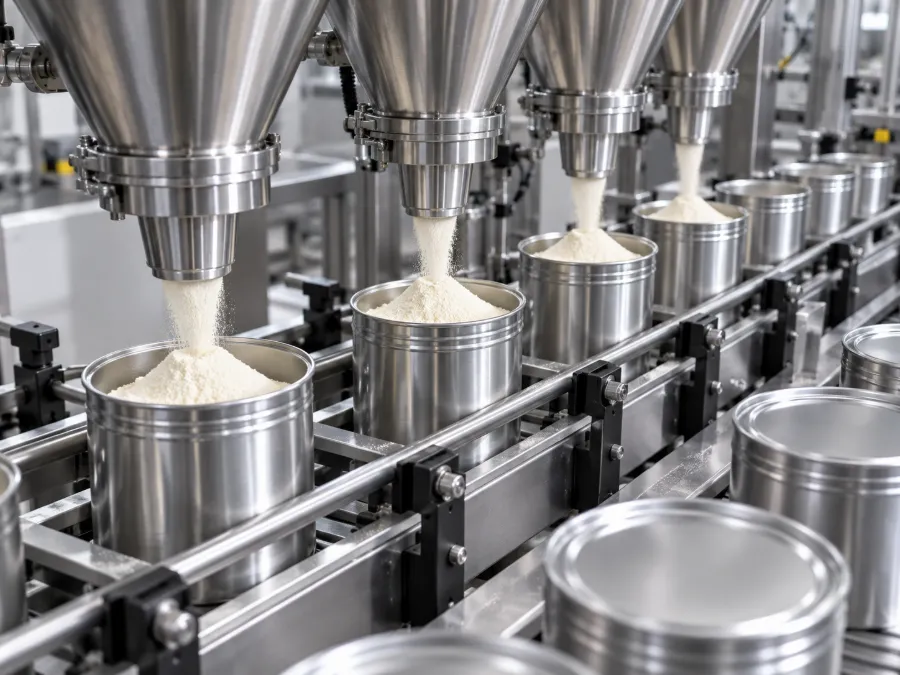
A powder is not a liquid with a different name. It is a collection of solid particles with air trapped between them. That air is the reason a fill that behaved at 9 a.m. can drift by lunchtime. Some powders pour like water and pack like cement. Others refuse to enter the screw at all. Still others arrive in the bag as two products because the fines travelled further than the coarse fraction.
Auger filling is volumetric metering, which is why flowability decides the outcome. The screw moves a volume per revolution. The weight depends on how densely the powder packs into that volume. Getting it right means understanding what flowability is in practice and how free-flowing and cohesive powders differ. It means knowing why bridging, compaction, and segregation cost money. It also covers what dust does to a machine and a room, and how to test a proposal before ordering.
Written for food, farmaceutico, nutraceutical, chemical, agricultural, and household-product manufacturers evaluating auger powder filling.
One disclosure: Tengzhuo builds servo auger fillers. Read every capability statement as a supplier’s claim on a published page, and verify it with your own powder.
- Auger filling weighs a volume. Anything that changes how the powder settles into the screw flight changes the weight.
- A powder name tells you almost nothing. Particle size distribution, loose and tapped density, and moisture do.
- Agitation is a variable to test, not a default. It can compact, aerate, shear, or segregate as easily as it can free a bridge.
- Test across a hopper emptying, not at a full one. Density and head of column both move during a run.
What Does Powder Flowability Mean for Auger Filling?
Flowability is not one property and there is no single number for it. In practice it is the sum of several measurable behaviors. Those include particle size distribution, particle shape and surface roughness, and the difference between loose and tapped bulk density. They also include moisture content, electrostatic charge, and how all of those shift with shop temperature and humidity. Sieving against a standard test sieve cloth, per ASTM E11, is the ordinary way to get a size distribution. A number without a sieve stack, a time, and a moisture reading is a description, not a measurement.
Now put that into a metering screw. An auger moves a volume of product with each revolution, and the machine controls revolutions, not grams. The weight delivered is that volume multiplied by the density the powder achieves inside the flight. That density depends on how the material entered and how much head of product sits above it. It also depends on how much air is still trapped between particles, and whether it has compacted since the last revolution. This is the mechanism behind almost every auger complaint. It is why a supplier’s accuracy figure cannot be read as a promise about your product.
Tengzhuo’s powder filling category page states a ±1% volumetric dispensing accuracy from Siemens servo control of the auger shaft. Read that as a claim measured on a particular material. Ask before you rely on it: which powder, at what density, over how many consecutive units, at what hopper level, at which fill weight? Servo drive helps, because it holds screw speed and angle repeatable. It lets you program a profile rather than a fixed rate. It does not stabilize the density of the material entering the flight.

How Do Free-Flowing and Cohesive Powders Behave Differently?
The two categories fail at opposite ends of the same process. A free-flowing granular material enters the flight faster than the screw can meter it, so the problem is control. Product continues to fall after the cycle ends. The fill dribbles from the nozzle, and the weight drifts high. A cohesive fine powder enters slower than the screw asks for it, so the problem is supply. The flight runs part-empty and the machine cavitates. The weight drifts low, with a spread that widens as the hopper empties.
Most real products sit between those poles and move along the scale with conditions. The same milk powder that runs well on a humid day bridges in a cold, dry room. A spice blend changes as its fines settle out. That is why the conversation must be about behavior, not names. “Coffee” covers a fine roast-and-ground, an agglomerated instant granule, and a chicory blend. That is three different machines. Ask for measurements, not a label.
| Where it shows up | Free-flowing granular material | Cohesive fine powder |
|---|---|---|
| Entering the flight | Floods in faster than the screw meters it. | Enters slowly; the flight can run part-empty. |
| Typical weight error | Drifts high, with tailing after the cut. | Drifts low, with a widening spread. |
| In the hopper | Runs on a flat, predictable surface. | Bridges, rat-holes, and holds a memory of compaction. |
| At the cut-off | Needs a positive shut-off or the fill keeps growing. | Sticks to the screw and nozzle, then releases in lumps. |
| What it demands | Controlled screw profile, shut-off valve, clean drop. | Reliable supply to the flight: agitation, hopper geometry, sometimes de-aeration. |
If your line runs both, say so early. Tengzhuo describes swapping the auger screw as a five-minute process alongside a touchscreen weight change. That is a supplier figure worth timing yourself with your own operators. Where the two differ as much as a granule and a fine flour, ask whether one frame with two screws beats two machines. Two separate machines bring their own hopper, agitator, and dust treatment. Our comparison of filling machines by product type covers the wider choice. Granule filling is a separate direction, where the problem is mostly control rather than supply.
Why Do Bridging, Compaction, and Segregation Matter?
Bridging is an arch of stable powder over the hopper outlet. The column above it rests on the arch instead of feeding the screw. The flight fills inconsistently, and the weight drops while the hopper still looks half full. Fine particle size, umidità, and smooth hopper walls all encourage bridging. So do a shallow cone angle and an outlet small relative to the particle size. A pause encourages it too, because vibration and flow are what keep an arch from forming. Tengzhuo describes an independent stirring motor driving internal agitators, separate from the auger, to break clumps and prevent cavitation. That is the right family of answer for a bridging material. It is not the whole answer, because hopper cone angle, outlet diameter, and liner finish decide how much help the agitator actually gets.
Compaction is quieter. Powder at the bottom of a deep column carries the weight of everything above it. It therefore meters denser than powder in a shallow hopper. As the level falls through a run, the head of column falls with it. A volumetric filler can drift in one direction across a shift. The practical consequence is real. Acceptance testing at a full hopper measures a different machine than the one your operators run at 4 p.m. Run the level down and record the weights.
Segregation is the defect that rarely shows up on the balance. If a blend contains a coarse carrier and a fine active or color, the fractions separate on every drop and every vibration. The first and last units of a batch then differ in composition while both weigh correctly. Drop height and the number of transfers between mixer and machine contribute. Hopper fill level and screw shear contribute too. A blend that must stay homogeneous is a design input for the layout. It is not a note in the margin of a quotation.
How Can Dust Affect the Filling Process and Machine Layout?
Dust is a measurement problem before it is a housekeeping problem. Product leaving the falling stream was weighed and then lost. A dust plume is a giveaway and a declared-weight risk at once. It also settles into drives and bearings. It contaminates the next SKU on a shared line, and it turns a changeover on an allergen into a documented cleaning operation rather than a wipe-down.
The serious version is safety. Many fine organic and inorganic powders can form an explosive dust cloud when suspended in air. Flour, sugar, spices, and some chemicals belong to that group. OSHA’s combustible dust guidance covers the standard controls. Those include dust collection, housekeeping, ignition-source management, and hazard analysis. Two boundaries matter. A machine’s general conformity marks are not a dust-explosion assessment. Equipment for a potentially explosive atmosphere follows its own conformity route. And a dust hazard analysis is a site-level exercise covering your room, ducting, and collection system. No machine quotation replaces it. Ask your own safety engineer before assuming a dust port settles it.
On configuration, Tengzhuo’s page describes sealed hoppers, dust covers, and dedicated vacuum extraction ports. Its FAQ states that connecting an industrial vacuum achieves a nearly dust-free environment. Treat that as a site requirement rather than a feature. The vacuum, ducting, and balancing must be bought, installed, and commissioned. Extraction airflow that is too strong can pull fines out of the flight or the falling stream. That changes the weight and the blend ratio. The dust system and the metering parameters must be tuned together.
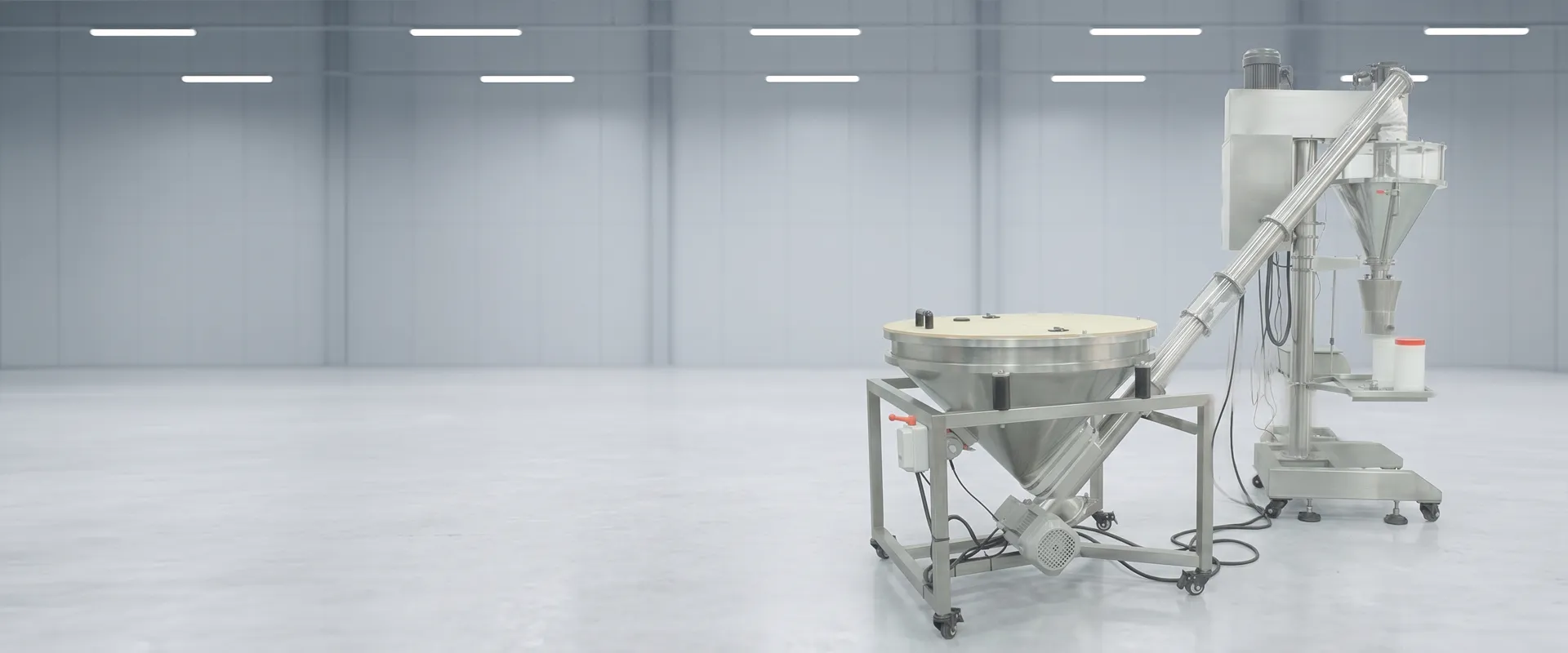
Layout follows from the same logic. Getting powder into an elevated hopper is a process of its own. Screw conveyor, vacuum lifter, or manual tipping each add a transfer point. Segregation and dust appear at each of those points. Ceiling height, cleaning access, and extraction take-off position belong in the enquiry. Where wet washdown is allowed belongs there too.
How Should Auger-Filling Performance Be Tested?
Test the behavior, not the demonstration. Three good containers from a supplier run prove the machine switches on. What you need is a sequence that mirrors a shift, with the weights written down. Separate accuracy from repeatability. The NIST/SEMATECH e-Handbook section on bias and accuracy states the distinction plainly. A filler can be tightly repeatable around a mean that is wrong for your declared weight.
Agree the count and the conditions before the trial. Run consecutive units at the smallest and largest fill you intend to run. Record weights in order with the hopper level beside them. Then run the level down to empty, recording throughout. That is where bridging and compaction show up. Check the outside of the container as well as the inside. Dust on a thread or a seal face is a downstream rejection. Our guide to testing filling machine accuracy before production sets out the procedure. The follow-up on accuracy issues covers what typically moves after commissioning.
| Test condition | What it reveals | What to record |
|---|---|---|
| Consecutive units at one setting | Repeatability, and any trend as the hopper drains. | Every weight in order, with time and hopper level. |
| Smallest and largest fill weight | Whether one screw covers your range or you need two. | Screw fitted, revolutions per fill, and the spread at each end. |
| Hopper run down to empty | Bridging, rat-holing, and the residue you will throw away. | The level at which flow degrades, and what remains behind. |
| Second lot, second supplier batch | How much of your problem is supply variation, not the machine. | Loose and tapped density for each lot beside the weight spread. |
| Changeover and clean-down | Whether the tool-free claims survive contact with your crew. | Elapsed time, tools used, and the number of parts touched. |
Ask for the Factory Acceptance Test to record the same data with your product rather than a demonstration material. Tengzhuo states that it provides English-language FAT videos before shipment. Make sure the video shows weights read out and settings on screen. A machine running is not a machine meeting your tolerance.
What Product and Site Information Should Buyers Provide?
A proposal is only as good as the inputs, and the useful inputs are measurements. Send the particle size distribution of the actual production material. Send the loose and tapped bulk density too. Note its moisture content and range, and flag temperature and humidity sensitivity. State the target weight and tolerance, the fill range one machine must cover, and your output in containers per hour. Send samples in the format you actually buy. Pouch geometry changes how powder is delivered and how much dust insertion raises.
Then describe the site honestly. Note what compressed air is available and whether an extraction system exists; if so, say where its take-off is. Give ceiling height and floor space, and say whether the hopper will be tipped, elevated, or conveyed. Describe your cleaning method and changeover frequency. Flag any allergen, hygiene, or regulatory constraint. Name every SKU you want on the machine, including next year’s. If a blend must stay homogeneous, say so. That changes the layout, not the parameter list.
Finally, state what passes. A quotation that answers a vague enquiry will be vague. A quotation that answers a written acceptance test can be checked against it later. Tengzhuo lists a semi-automatic powder filler alongside its servo-driven machines. The right first question for a small or multi-SKU operation is simple: does the manual station meet the same acceptance test, at the volume you actually run?
Tengzhuo builds the machines discussed here. Accuracy figures, changeover times, and dust-control statements are supplier claims to verify on your own material, not measured results. No accuracy level transfers between powders. No dust-explosion conformity claim is made for any machine. Hazardous-area questions need a site assessment by your own safety engineer.

Domande frequenti
Can one auger filler handle powders with different bulk densities?
Often yes, but not with one parameter set. Because metering is volumetric, a denser powder delivers more grams from the same screw revolution. Each product therefore needs its own recipe, and a wide density gap may need a different screw. Tengzhuo describes swapping the screw and changing the weight parameter as a short process. Verify it by weighing consecutive units of each product on the same machine, in the same conditions.
How should powders that bridge be tested?
With production-representative material, a realistic hopper level, and a run down to empty. Record the level at which flow degrades, the weights that follow, and what remains afterwards. Test a second lot before concluding anything, since moisture and fines content vary between batches. Only then compare fixes. Agitator settings, hopper geometry, outlet size, or a change in delivery to the machine are all fair candidates.
Can hopper agitation improve every powder?
NO. Agitation that frees a bridging fine powder can compact a material that already flows. It can whip air into another, shear fragile granules, or accelerate segregation in a blend. Treat the agitator as a variable in the trial. Run with it off, then at each setting, and record the weight spread beside the hopper level. That way the effect is visible rather than assumed.
Can dust collection affect the machine configuration?
Yes, in both directions. Extraction at the filling head removes the dust that would otherwise settle on the container and in the drives. But airflow that is too strong can pull fines out of the metered flight or out of the falling stream. That shifts the weight and the blend ratio. Ports, duct sizing, and balancing are part of commissioning. Repeat the metering check with the extraction running as it will run in production.
How much powder is needed for a representative trial?
Send enough to fill and empty the hopper twice at your fill weight. Add a retained sample, and a second lot if you can supply one. Ask the supplier for hopper capacity and what its test rig consumes at your container size before you commit a quantity. A half-kilogram sample shows how a powder pours from a beaker. It does not show bridging, compaction drift, or segregation.
Flowability is the specification that decides an auger filling project. It is measured rather than named. Send the numbers and describe the room. Insist on a trial that runs your powder to the bottom of the hopper with weights written down. A machine that passes that test is a purchase. A machine that passes a demonstration is a video.

Continua a leggere
Scopri ulteriori approfondimenti dai nostri esperti di macchinari per l'imballaggio
Wrap-Around, Front-and-Back, and Flat-Surface Labeling Compared
Pressure-sensitive labeling splits by how the container moves and where the label datum sits. Compare the three methods, then send the samples a quotation needs.
Leggi l'articolo
Shrink Sleeve Defects: Wrinkles, Distortion, and Label Jams
Sleeve defects sort into four groups: shrink, position, feed, and heat damage. The evidence to collect before any tunnel or applicator setting gets changed.
Leggi l'articolo
Filling High-Viscosity Products with Particles: Methods and Trial Requirements
Viscosity, temperatura, and particles decide the filling method, not the catalogue. How to weigh piston and pump routes, plan cleaning, and run a real product trial.
Leggi l'articoloPronti per aggiornare la vostra linea di confezionamento?
Mettiti in contatto con i nostri ingegneri per una consulenza gratuita e una proposta di attrezzatura su misura all'interno 24 ore.
Ottieni un progetto di layout di linea CAD 3D gratuito
- Prezzi diretti in fabbrica
- Tempi di consegna rapidi
- Componenti globali di alto livello
- Supporto post-vendita dedicato


