Shrink Sleeves for Round, Square, and Irregular Bottles
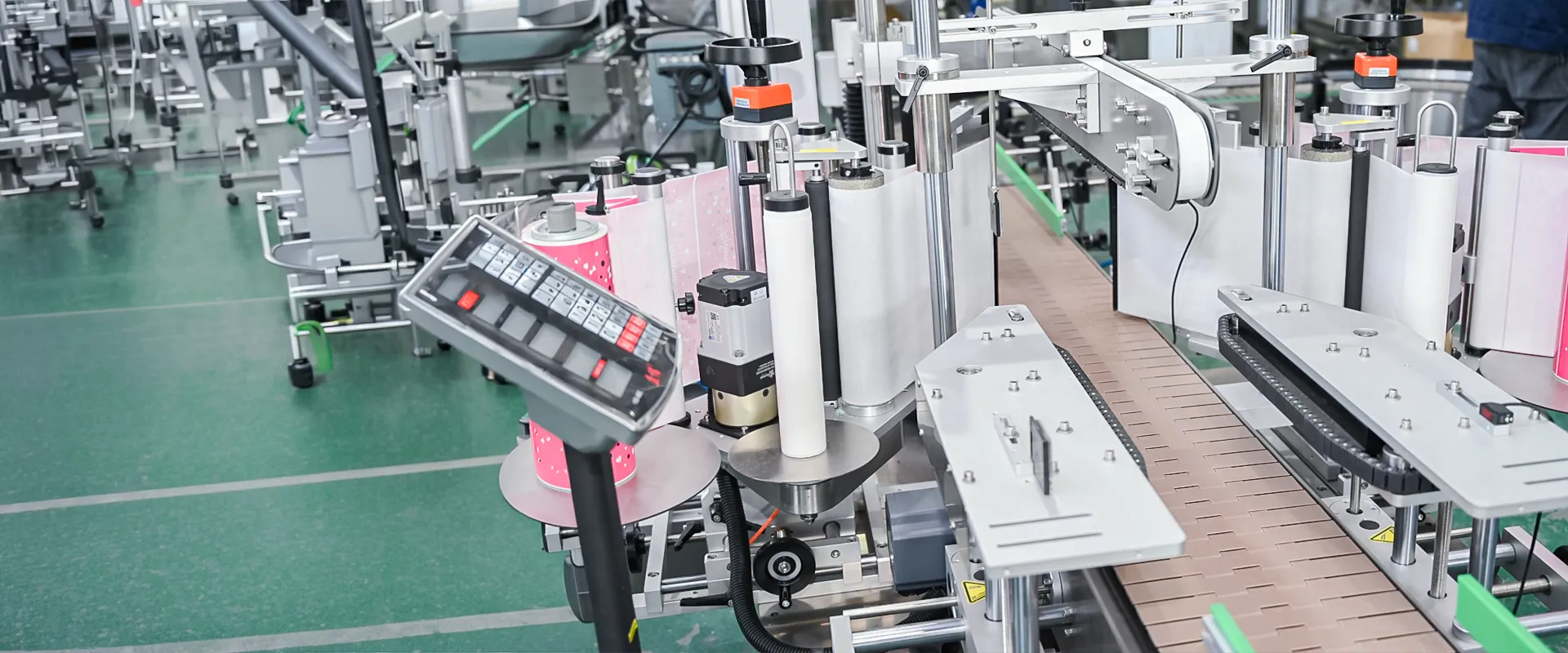
A shrink sleeve reaches its final shape by shrinking, not by being pulled over the bottle. It arrives as a flattened tube of film, is opened around a mandrel, cut to length, slipped onto the moving container, and only then told what shape to take by heat. That sequence is why container geometry, not machine brand, drives a sleeving project: the bottle determines how far the film moves, where, and how long heat acts on it.
Buyers usually meet this as separate symptoms—a wrinkle at the shoulder, graphics drifting a few millimeters, a sleeve bridging a recess instead of following it. Those are one interaction seen from three angles: geometria, film behavior, and heat distribution. Separating them, and pinning down what a trial needs before anyone quotes, is where a sleeving project starts.
Written for packaging buyers, brand managers, and production teams specifying shrink sleeves for shaped containers.
One disclosure: Tengzhuo builds the equipment discussed here, so read every capability statement as a supplier’s claim attributed to a published page, and verify it against your own bottles and film.
- The sleeve is fitted by shrinkage. Local diameter changes decide how much film movement each band of the artwork must absorb.
- Round, square, and contoured bottles fail in different and predictable places: the seam, the corners, and the shoulder or base.
- Film selection and tunnel type are one decision. Shrinkage in each direction has to be reconciled with the heat that can reach the shape.
- A wrinkle-free claim means nothing until it is earned on your bottles, your film lot, and your written acceptance limit.
How Does Bottle Shape Affect Shrink Sleeve Application?
Start with what the film knows before it meets your bottle. Sleeve stock is tubular film flattened and wound onto a roll, described by two measurements: lay-flat width, which becomes the circumference of the finished sleeve, and cut length along the web, which becomes sleeve height. Everything downstream reconciles those two numbers with the corresponding distances on your container.
On a true cylinder that reconciliation is simple, because circumference is the same at every height. On a real bottle it is not. A shoulder reduces diameter quickly over a short vertical distance, a base flares back out, and a panel recess cuts a flat into a round section. Each feature forces one band of film to move further than the band beside it, and film cannot transfer material across its surface once shrinking starts. The visible result is a wrinkle, a stretch mark, or a shallow bridge.
Two consequences follow. Artwork is affected as much as surface: a graphic that reads correctly on a cylinder distorts where local diameter changes. And the settings that matter—cut length, feed tension, mandrel size, tunnel heat, conveyor speed—are coupled through the shape, so fixing one defect usually moves another.
It is worth stating what is not happening. The sleeve is not stretched over the container: the applicator opens the flattened tube, the container enters it, and heat does the fitting. A skin-tight claim that ignores your geometry describes a film outcome, not a machine capability.
How Do Round, Square, and Irregular Bottles Differ?
The three families buyers bring differ less in how the sleeve is applied than in where the film must go and what gives way first.
| Container family | What the film must absorb | Where defects usually appear | What to confirm first |
|---|---|---|---|
| Round or cylindrical | An even reduction in diameter, with the neck and base carrying most of the difference. | Seam position and overlap; pleating at the base; looseness just under the neck. | Maximum and minimum circumference at fixed heights, and whether the body is truly round or slightly oval. |
| Square or flat-sided | Sharp changes in direction at the corners, plus panels the film must not pull into. | Corners, where film bridges the radius or gathers; panel edges, where waviness shows under raking light. | Corner radius, panel flatness, and whether the label area is one panel or wraps an edge. |
| Irregular or contoured | Large diameter changes over short heights, in more than one direction at once. | Shoulders and recesses; trapped air that cannot escape before the film sets; distorsione grafica. | A sectional profile, not just a capacity, and how much heat the shape can accept. |
A square bottle is not harder than a round one in every respect. Its flat panels need little shrinkage, and its corners give the film a defined place to work. The difficulty is concentrated rather than spread out, which usually means a narrower heat window—enough to pull the corners down, not enough to distort the panels.
Contoured bottles are the opposite case. Diameter changes continuously, so no single setting is exactly right anywhere, and the film has to draw from neighboring bands. Tengzhuo’s shrink sleeve category page puts multi-zone steam tunnels forward for highly contoured and hourglass containers, describing the goal as wrapping without trapped air. Treat that as a claim about a configuration and test it on your own profile; the same page assigns electric tunnels to moisture-sensitive products and sites without a boiler—a different trade-off, not a lesser machine.
When Is Container Orientation Required?
Orientation is a question about rotation, not fit. It matters the moment the package has a defined front—a panel that must face the shopper, a seam that must hide behind a feature, or a graphic that must align with a moulded facet.
Two mechanisms are commonly confused, and the distinction saves money. A color-mark sensor reads printed marks on the moving web and controls where along the sleeve the cut falls, which sets vertical placement; it does not know how the bottle is rotated. Putting a seam behind a flat, or a front panel facing forward, needs the container presented at a known angle—by an indexing table, a mechanical stop, or a fixture engaging a moulded feature. Tengzhuo’s page describes photoelectric sensors reading printed color marks to cut and apply at the target height; that is vertical registration, not orientation.
The practical question is whether orientation is worth the station it costs. If the bottle has a usable moulded feature, orienting it is usually straightforward and the artwork can be built around it. If it has none, redesigning the sleeve to tolerate rotation—a repeat pattern, or a seam on a facet—is often cheaper than an indexer. Note that a positioning function does not transfer between machines: Tengzhuo’s round bottle positioning and labeling machine sits in its pressure-sensitive range and should not be assumed to carry over to a sleeve applicator.
How Are Sleeves Fed, Opened, and Positioned?
Follow the film. It unwinds as a flattened tube, passes a feed that pulls it at controlled tension, opens on a mandrel, is cut to length, is held while the container rises into it, and is released so the container carries it into the tunnel. Each step has a shape dependency, and defects seen at the tunnel exit are usually made two or three steps earlier.
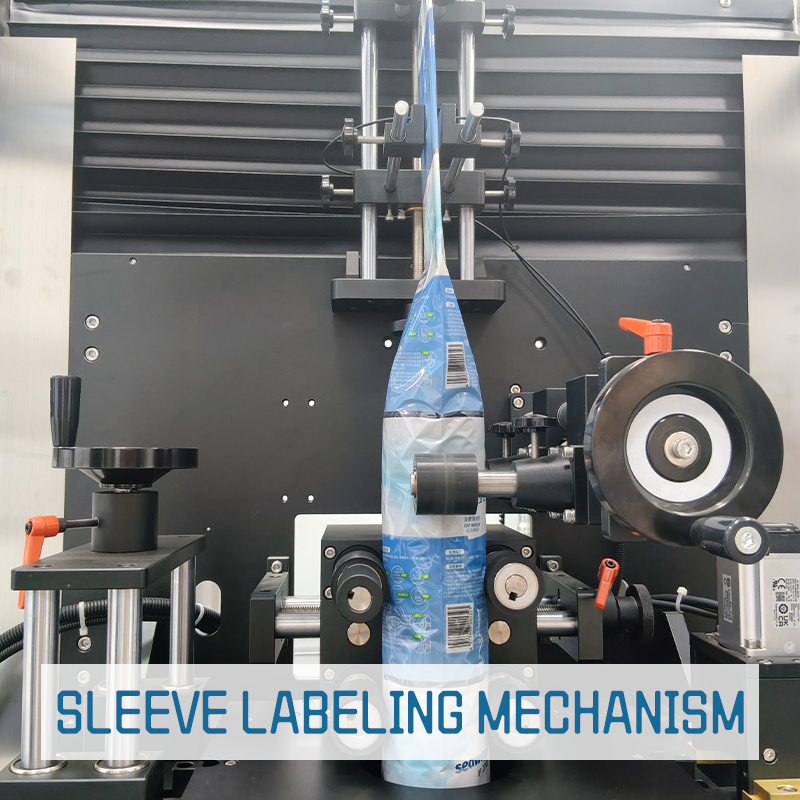
Feeding is where tension and slip show up. Tengzhuo describes a dual-drive synchronized feeding arrangement, developed in 2018, that it credits with eliminating slippage, extending blade life, and producing flat cuts. The test is narrow: run your own film at your own speed and inspect the cut edge. A ragged cut does not stay in the cutting station—it becomes a sleeve of varying height that shrinks unevenly.
Opening is the mandrel’s job, and the mandrel is matched to the sleeve diameter rather than the bottle. Tengzhuo’s guidance is that a changeover means swapping the center mandrel to suit the new sleeve diameter, using a quick-release arrangement it calls tool-free. If your portfolio mixes diameters, time that swap with your own operators and film.
Positioning is where the shape dependencies collect, and they are easier to work with as a list of consequences than as a paragraph.
| Machine setting | Follows from the container… | …and shows up as |
|---|---|---|
| Mandrel size and opening stroke | Lay-flat width, derived from the largest circumference the sleeve must pass over. | Sleeves that will not open cleanly, or that collapse before the container reaches them. |
| Cut length | Vertical distance to be covered, less the allowance the film shrinks on that axis. | Artwork too high or low, exposed base, or film creeping over the neck finish. |
| Feed tension | Film gauge and print layer, and how much web sits in the opening zone at once. | Varying cut length, later recovery in the tunnel, and distortion in the graphics. |
| Registration method | Whether the artwork carries a readable mark and whether the body has a feature to index. | Seam and panel placement that drifts lane to lane, batch to batch. |
| Tunnel zones and dwell | Total diameter change, and how much heat the container wall can take. | Corners that will not clean up, or scorched film and deformed containers. |
How Do Film and Tunnel Conditions Affect Different Shapes?
Film is specified in two directions and a sleeve uses both. The web travels through the machine along the machine direction, which becomes sleeve height; circumference comes from the transverse axis across the flattened tube. Shrinkage differs between the two, and a data sheet quotes them separately—which is what ASTM D2732, the standard test method for unrestrained linear thermal shrinkage of plastic film, exists to measure. Ask for figures for your exact grade, at your running temperature, in both directions. A sleeve designed on the assumption that the axes behave alike will wrinkle on the one that shrinks less.
Gauge matters twice. Thinner film conforms more readily into a corner or recess because it has less mass holding it across the feature, and it cools faster; it also tolerates less before a cutting or feeding error becomes visible. Tengzhuo’s page states that its multi-point rotary blade handles extremely thin PVC, PETG, and OPS films, and elsewhere lists PVC, PET, and OPS—an inconsistency worth noting, because the grade rather than the family decides the outcome. Tensile behavior is characterized by ASTM D882: film pulled hard in the feed, or forced open beyond its range, can recover later in the tunnel, where it reads as distortion.
The tunnel is where the shape is finally answered. Heat has to reach every part of the sleeve at roughly the right dose, and a contoured or flat-sided bottle presents surfaces at different distances from the heaters or steam outlets, at different angles, and with different amounts of air trapped behind the film. That is what zoning is for, and why the tunnel families trade off: the conditions that favor one—a boiler, a moisture-tolerant product, a demanding profile—rule the other out. Our steam versus electric tunnel comparison covers that choice.
One failure mode deserves a warning, because the instinct to fix it is wrong. When a shoulder or corner does not clean up, raising temperature or slowing the conveyor can work—until graphics distort or a thin wall softens in the tunnel. More heat is a trade, not a remedy.
What Should Be Included in a Bottle Trial?
A trial settles an argument with evidence, and only if the inputs represent production. The most common way to lose is to win: bottles from the good end of a tolerance range, film from a single roll, and a result nobody can repeat on the line.
Send bottles from at least two production lots, including units you would still ship but would not show a supplier—the oval bodies, the sink marks, the short corners. Alongside them send a dimensional survey, not a drawing alone: maximum and minimum circumference at several fixed heights, corner radius, panel flatness, and the height to be covered. For film, send the actual grade and gauge with two-axis shrinkage data, in a quantity that allows a sequence rather than a demonstration. If the container is filled in production, trial it filled or at matching weight.
Agree the acceptance standard before the first sleeve is cut, in writing, with photographs. Four items cover most of it: graphic position tolerance against a fixed feature; how much surface texture is acceptable at shoulder, corners, and base, and at what viewing distance; where the seam and any perforation must land; and what happens at the extremes of your tolerance rather than at the mean. A wrinkle-free promise is worth nothing until it is attached to those four. If the artwork carries a barcode, verify it after shrinking: GS1’s barcode standards exist because a symbol that printed well can read poorly once distorted by film movement or caught across a seam.
Finally, record the settings that produced the accepted sample: mandrel, cut length, feed tension, registration behavior, tunnel zones, and line speed. Fix the measurement method alongside them; the NIST/SEMATECH e-Handbook on bias and accuracy is the reason to weigh and gauge the same way at every check, or the comparison measures your method rather than the machine. That record makes the machine quotable.
Tengzhuo builds the applicators and tunnels named here, so every capability line is a supplier claim to verify on your own bottles and film. Shrink-recovery and temperature figures belong to the specific grade and container you buy, not to this article.

Domande frequenti
Can one machine handle round and square bottles?
The same applicator body often can, once the change parts and settings fit both—but that is a project question, not a catalog one. The mandrel follows sleeve diameter, cut length follows sleeve height, and the tunnel has to deliver the right heat dose to both shapes. Tengzhuo’s published guidance is that a format changeover means swapping the center mandrel; whether both your formats sit inside one mandrel range and one tunnel window is what a trial answers.
Do square bottles require a different tunnel?
Not necessarily a different tunnel, but usually a different heat profile. A flat-sided container has panels needing little shrinkage and corners needing a great deal, so the useful question is whether the tunnel can be zoned to hold heat back from the panels while working the corners. If it cannot, expect either corner lift or panel distortion. Photograph the corners under raking light before concluding you need new equipment.
How is sleeve lay-flat width confirmed?
From the container, not the artwork. Measure the largest circumference the sleeve must travel over—often the body rather than the neck—add the overlap the design needs, and halve it to get the flattened width. Then confirm the film supplier can hold that width in your grade and that the mandrel range covers it. Because shrinkage differs between the two axes, finished circumference is not cut circumference.
Can transparent film affect sensor selection?
Yes, and it is a constraint to declare rather than discover at commissioning. Registration normally relies on a mark the sensor can see; a fully clear sleeve with no opaque print can leave nothing to read. The project then has to add a mark, change the detection method, or accept placement that is timed rather than registered. State the film and the artwork together in your enquiry.
How many bottle and film samples are needed?
Enough to run two lots of bottles and at least one full film lot, in a sequence long enough to include a start-up, a steady state, and a changeover—plus filled or surrogate weight if the container flexes. A handful of ideal samples proves the machine runs; it does not prove your package works. If a short demonstration is offered as the whole evidence base, ask what the acceptance record says about your tolerance range.
Container shape is not a detail handed over after the machine is chosen. It sets the mandrel, cut length, the film’s two-axis shrink budget, the heat the tunnel must deliver, and whether the artwork can be registered at all. A buyer who says where round, square, and contoured bottles are likely to fail gets a proposal that answers those places.

Continua a leggere
Scopri ulteriori approfondimenti dai nostri esperti di macchinari per l'imballaggio
Wrap-Around, Front-and-Back, and Flat-Surface Labeling Compared
Pressure-sensitive labeling splits by how the container moves and where the label datum sits. Compare the three methods, then send the samples a quotation needs.
Leggi l'articolo
How Powder Flowability Affects Auger Filling
Air trapped between particles is why powders bridge, compact, and segregate. How flowability drives auger selection, testing, and what to send with an enquiry.
Leggi l'articolo
Shrink Sleeve Defects: Wrinkles, Distortion, and Label Jams
Sleeve defects sort into four groups: shrink, position, feed, and heat damage. The evidence to collect before any tunnel or applicator setting gets changed.
Leggi l'articoloPronti per aggiornare la vostra linea di confezionamento?
Mettiti in contatto con i nostri ingegneri per una consulenza gratuita e una proposta di attrezzatura su misura all'interno 24 ore.
Ottieni un progetto di layout di linea CAD 3D gratuito
- Prezzi diretti in fabbrica
- Tempi di consegna rapidi
- Componenti globali di alto livello
- Supporto post-vendita dedicato


